
Sri Lanka's 8 UNESCO World Heritage Sites: A Study Guide for Students
· 5 min read · StudyWay Editorial
Quick answer: Sri Lanka has eight UNESCO World Heritage Sites: six cultural (the Sacred City of Anuradhapura, the Ancient City of Polonnaruwa, the Ancient City of Sigiriya, the Golden Temple of Dambulla, the Sacred City of Kandy and the Old Town of Galle and its Fortifications) and two natural (Sinharaja Forest Reserve and the Central Highlands). Five of the cultural sites lie close together in the Cultural Triangle, so several can be visited in one week.
For a small island, Sri Lanka has an extraordinary concentration of world heritage: ancient capitals, cave temples, a rock fortress, a colonial fort and two remarkable natural areas. The full list is published on the UNESCO World Heritage website. Here is what each site is, why it matters and how to visit.
The six cultural sites
1. Sacred City of Anuradhapura
Anuradhapura was Sri Lanka's first great capital and remained the political and religious centre for well over a thousand years. Its highlights are the sacred Sri Maha Bodhi tree, said to have grown from a cutting of the tree under which the Buddha attained enlightenment, and the huge stupas of Ruwanwelisaya and Jetavanaramaya. It is still an active place of pilgrimage. Visitors should wear white or light clothes that cover the shoulders and knees.
2. Ancient City of Polonnaruwa
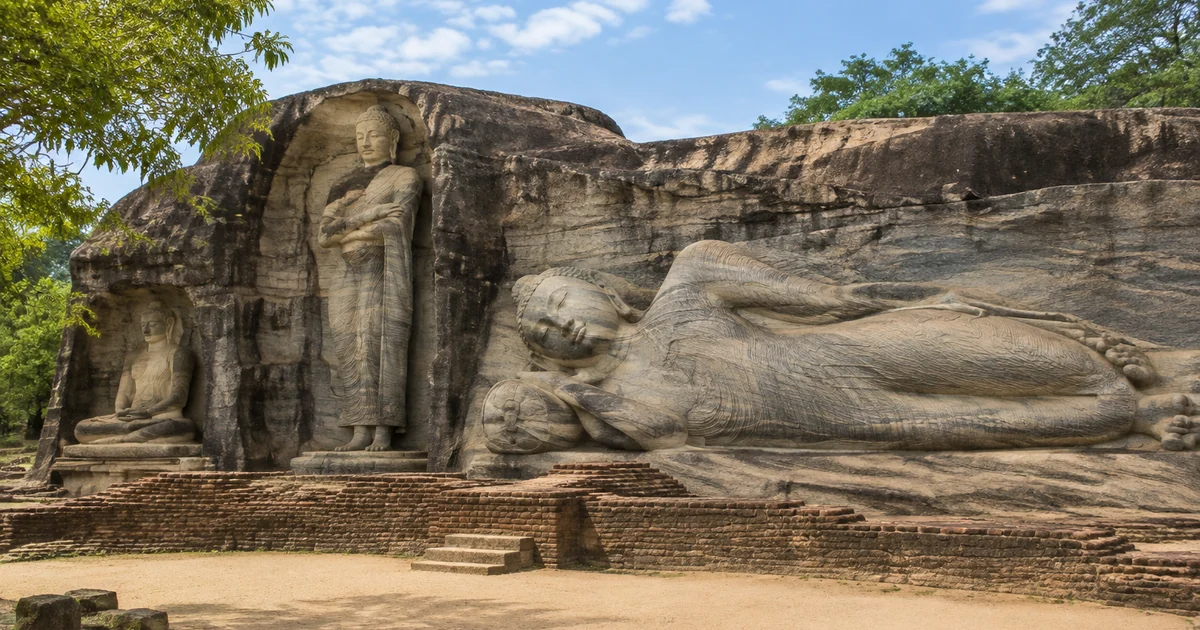
Polonnaruwa became the capital after Anuradhapura, in the medieval period. Its ruins are compact and well preserved, including the Royal Palace, the Sacred Quadrangle and Gal Vihara, where four large Buddha figures are carved into a single granite rock. Many visitors explore by bicycle.
3. Ancient City of Sigiriya
Sigiriya is a 5th-century rock fortress rising sharply from the plains. A king built a palace on its summit, with gardens, pools and famous frescoes on the way up. The climb passes the "Lion Gate", where giant stone paws mark the entrance to the final stairs. Go at opening time to avoid the heat and crowds.
4. Golden Temple of Dambulla
The Dambulla cave temple complex has five caves under a huge rock, filled with Buddha statues and ceilings covered in paintings. It is one of the best-preserved cave temple sites in Sri Lanka, and only a short drive from Sigiriya.
5. Sacred City of Kandy
Kandy was the last royal capital of the Sinhalese kings. It is home to the Temple of the Sacred Tooth Relic, one of the most important Buddhist sites in the world. Each year the city hosts the Esala Perahera, a great procession of dancers, drummers and decorated elephants.
6. Old Town of Galle and its Fortifications
Galle Fort, on the south coast, is a walled town first fortified by the Portuguese and greatly expanded by the Dutch. Its ramparts, lighthouse, churches and colonial streets make it one of the finest examples of a European-built fortified town in South and South-East Asia.
The two natural sites
7. Sinharaja Forest Reserve
Sinharaja is a lowland rainforest in the south-west, rich in plants and animals found only in Sri Lanka, especially birds, frogs and reptiles. Visits are on foot with a local guide.
8. Central Highlands of Sri Lanka
The Central Highlands include Horton Plains National Park, the Peak Wilderness Sanctuary around Adam's Peak, and the Knuckles Conservation Forest. They protect cloud forests and many species that live nowhere else.
How to see several sites in one trip
Anuradhapura, Polonnaruwa, Sigiriya and Dambulla lie within a few hours of each other in the Cultural Triangle, and Kandy is a short drive south. Because the sites sit so close together, private tours of Sri Lanka often cover four or five of them in a week, then continue to the hill country and Galle.
A sample route:
- Day 1: Anuradhapura.
- Day 2: Sigiriya and Dambulla.
- Day 3: Polonnaruwa.
- Days 4 to 5: Kandy.
- Later: Galle Fort on the south coast.
Tips for visiting heritage sites
- Dress modestly at religious sites, covering your shoulders and knees, and remove your shoes and hat.
- Start early, as the dry zone gets very hot by midday.
- Carry water, sunscreen and socks, as stone paths get hot underfoot.
- Never pose with your back to a Buddha statue.
- Buy entry tickets at the official counters.
What tourism and hospitality students can learn
- History: how Anuradhapura, Polonnaruwa and Kandy show the development of Sri Lanka's kingdoms.
- Heritage management: how sites balance tourism, worship and conservation.
- Colonial history: what Galle Fort shows about Portuguese and Dutch rule.
- Biodiversity: why Sinharaja and the Central Highlands are protected for their endemic species.
- Educational trips: how schools and universities can plan heritage field visits.
To explore courses in this field, see StudyWay's Hospitality & Events courses.
Frequently asked questions
How many UNESCO World Heritage Sites does Sri Lanka have?
Eight: six cultural and two natural.
Which UNESCO site in Sri Lanka is the most famous?
Sigiriya is the best known, followed by the Temple of the Tooth in Kandy and Galle Fort.
Can you visit several UNESCO sites in one day?
Yes. Sigiriya and Dambulla are often combined in one day, as are Polonnaruwa and a safari nearby.
What should I wear to Sri Lanka's sacred sites?
Loose clothes covering the shoulders and knees. White or light colours are best at Anuradhapura.
Are Sri Lanka's UNESCO sites good for school and university trips?
Yes. Sites in the Cultural Triangle are close together, so a 3 to 4-day educational trip can cover history, religion, archaeology and conservation.
Related tourism guides
How to Plan a Trip to Sri Lanka: An Itinerary Planning Guide for Tourism Students
Learn itinerary planning with Sri Lanka as a case study: seasons by region, trip length, route design, visas and booking order, explained for tourism students and travellers.
Read guide
Sri Lanka's National Parks: A Study Guide to Wildlife, Conservation and Ecotourism
A study guide to Sri Lanka's national parks: Yala, Wilpattu, Udawalawe, Minneriya and Kumana, human-elephant conflict, ecotourism and responsible visiting.
Read guide
Sri Lanka Tourism Industry 2026: Statistics, Top Markets and Career Opportunities
Sri Lanka welcomed over 2.3 million tourists in 2025. Key statistics, the top source markets, industry trends and the careers and skills students need in tourism.
Read guide